CAA News Today
Communing with Dore Ashton
posted by CAA — April 28, 2017
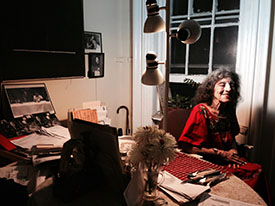
Dore Ashton at the kitchen table in her home on East Eleventh Street, New York, New York, 2011 (photograph © Madeline Djerejian)
“Communing with Dore Ashton” by Michael Corris has just been published at the open-access Art Journal Open. Corris, an artist and author based in Dallas, writes that Ashton, who died on January 30, was “one of the most energetic, widely published, and politicized American writers on art, and one of the chief proponents of the artists of the New York School (she decried the label Abstract Expressionism).” In addition to Corris’s personal memories of Ashton and their friendship, the project includes the audio and transcribed text of their 2011 conversation about Ashton’s experiences in New York art world during the 1950s and 1960s. Also included is a 2015 film by the artist Alfredo Jaar, Dore Ashton, you know, which features Ashton speaking candidly about her life, writing career, politics, and relationships with artists and writers, among them Harold Rosenberg, Philip Guston, and Louise Bourgeois. Recent photographs by Madeline Djerejian and Polly Bradford-Corris portray Ashton in her working and living spaces in New York City and Springs, Long Island.
Staff Interview: Fernando Zelaya
posted by CAA — April 24, 2017
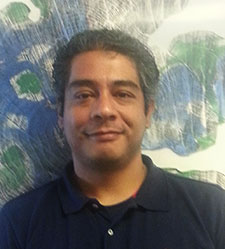 The next in a series of interviews with staff members is a conversation with Fernando Zelaya, CAA controller.
How long have you worked at CAA?
I have been at CAA since December 2012—four years, four months.
What do you do at CAA?
I am the controller, in the Finance Department.
What does CAA mean to you?
CAA to me is a medium for all art scholars to come together and be a part of a community. It’s also a place to share with each other, and to teach each other.
Can you talk about one of your favorite member moments?
Since I interact with members mostly at the conference, I’ll tell one story here and add another in the conference question later on. My favorite member moment was when I helped an elderly member who reminded me of my grandmother. She had such vigor and enthusiasm and seemed genuinely happy to be at the conference. That made my day.
What do you like best about the arts and working in the arts?
What I like best is meeting and working with artists. In my daily life and my earlier years, I had never interacted with artists. Now, having worked for the Dia Art Foundation as well as CAA, I have learned to appreciate art more than I used to, because now I better understand the meaning behind the art.
Do you have a favorite moment from the Annual Conference?
Once at registration I was berated by a flustered member who was late to a session and wanted to get his ticket quicker than was possible. The nice moment came when he returned to my booth after the session was over and gave me a sincere apology.
People interested in art can sometimes rebuff things like sports. But you’re interested in sports like soccer and baseball. Do you see a conflict?
I think that art and sports have more in common than people think. Both require years of hard work to perfect, and both need a combination of grace and power to achieve the objective of the piece (in art) or to score (in a game). It takes grace to stop a soccer ball or save a shot coming toward you at fifty to sixty miles per hour, or to hit a baseball with a bat when both objects are about three inches wide. That kind of skill, to me, is just as beautiful as a stroke of a brush or a poem that can draw a tear or bring about a smile.
You’re also interested in science fiction. Are there any new television shows or movies that have piqued your interest?
Science fiction is my favorite type of television show or movie. My favorite is Doctor Who, because of its sheer brilliance and how it has evolved over the last fifty-three years. The series even survived being off the air, only living in print and audio for almost ten years. The best new show I have seen this year is The Man in the High Castle, which takes us to a world where the Axis powers won WWII and have divided the United States among them. I am also a big fan of the Marvel and DC movies. I love these types of shows or movies because it is fun to immerse myself for a couple of hours—okay, maybe more than a couple—and go somewhere magical or even quite insane.
New in caa.reviews
posted by CAA — April 21, 2017
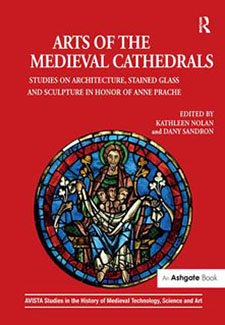 Evelyn Staudinger reviews Arts of the Medieval Cathedrals: Studies on Architecture, Stained Glass and Sculpture in Honor of Anne Prache, edited by Kathleen Nolan and Dany Sandron. The essays “honor the Sorbonne professor’s rich contributions to medieval art and architecture.” Covering a wide variety of topics, “the editors and authors have done a fine job celebrating Prache’s great intellectual acumen, diplomatic gifts, and warmth as a human being, while leaving behind erudite ‘memories’ and a wealth of new ideas.” Read the full review at caa.reviews.
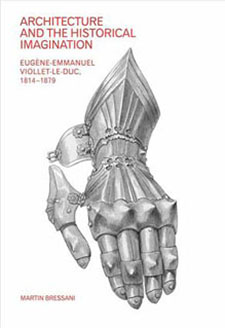 Jessica Basciano examines Architecture and the Historical Imagination: Eugène-Emmanuel Viollet-le-Duc, 1814–1879 by Martin Bressani. Viollet-le-Duc is “the nineteenth-century French architect, restorer, and theorist whose numerous and diverse activities continue to enthrall and perplex historians.” Although the “book’s complex arguments could be made clearer by offering more straightforward exposition,” “Bressani’s intellectual biography stands out in the landscape of Viollet-le-Duc studies because it offers a unified narrative based on the distinctive premise that the architect was motivated consistently by a form of pathological mourning.” Read the full review at caa.reviews.
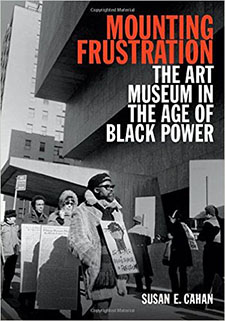 Anne Monahan reads Mounting Frustration: The Art Museum in the Age of Black Power by Susan E. Cahan. Framing her review with a discussion of recent police shootings of unarmed African American males and subsequent artists’ responses, Monahan presents Cahan’s “finely grained history of the New York art establishment’s attempts circa 1970 to reckon with African American representation.” Utilizing “close readings of archival documents, interviews, and secondary sources,” Cahan shows how demands by activists “conditioned the museums’ exhibition and hiring practices for decades thereafter.” Read the full review at caa.reviews.
Presentation on Fair Use at UCLA
posted by CAA — April 19, 2017
CAA is hosting “Fair Use and the Visual Arts,” a presentation and panel discussion led by Peter Jaszi, Professor, Washington College of Law, American University, on Friday, May 5, 2017. The event will focus on the College Art Association’s Code of Best Practices in Fair Use for the Visual Arts and will take place at the UCLA Library from 10:00 AM to 2:00 PM. Lunch will be served.
Come join the conversation! Please RSVP to give us your lunch preferences, and when you do, please share your specific Fair Use questions so our presenters can break it down for you.
For more information: https://www.library.ucla.edu/events/code-best-practices-fair-use-visual-arts.
This event is made possible by a grant from the Andrew W. Mellon Foundation.
New in caa.reviews
posted by CAA — April 14, 2017
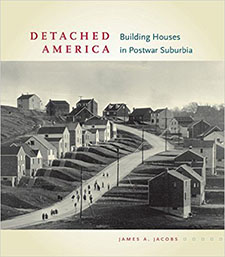 Ryan Donovan Purcell reviews Houses for a New World: Builders and Buyers in American Suburbs, 1945–1965 by Barbara Miller Lane and Detached America: Building Houses in Postwar Suburbia by James A. Jacobs. These two studies “examine the development of suburban communities through the lens of architectural history, and yield fresh insight into the origins of ubiquitous suburban housing forms.” Read the full review at caa.reviews.
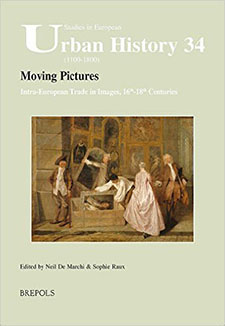 Thijs Weststeijn reads Moving Pictures: Intra-European Trade in Images, 16th–18th Centuries, edited by Neil De Marchi and Sophie Raux, and European within Reach: Netherlandish Travellers on the Grant Tour and Beyond (1585–1750) by Gerrit Verhoeven. The two books “happily complement each other in mapping different dimensions of early modern artistic exchange, mostly from the Low Countries to Italy.” Read the full review at caa.reviews.
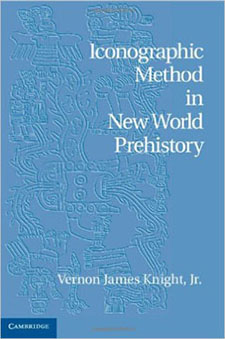 Amanda V. Gannaway examines Vernon James Knight Jr.’s Iconographic Method in New World Prehistory. Addressing a “lack of methodological rigor” in the study of the ancient Americas, the author “proposes a method for iconographic analysis.” The book is “novel not by reinvention but by taking on the daunting task of bringing relevant literature from two disciplines into dialogue with each other.” Read the full review at caa.reviews.
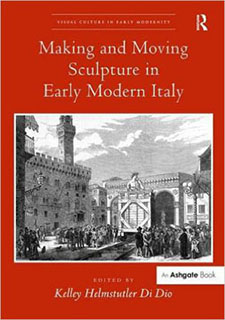 Francesco Freddolini discusses Making and Moving Sculpture in Early Modern Italy, edited by Kelley Helmstutler Di Dio. The collection of ten essays marks “an important addition to the growing field of studies on the mobility and materiality of sculpture,” focusing on the “process, techniques, and technologies” that shed “light on the many decisions made by sculptors during their creative process.” Read the full review at caa.reviews.
The Art Bulletin Redesign
posted by CAA — April 13, 2017
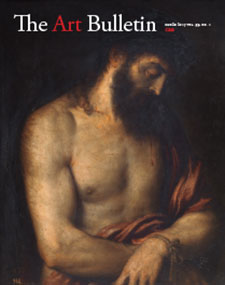 A few weeks ago we unveiled a new website design at CAA and today we present another new change. This time, it’s arriving to your mailbox. If you are a subscriber of The Art Bulletin, you may notice that the March 2017 issue looks different. Thanks to the hard work of Nina Athanassoglou-Kallmyer, editor-in-chief of the publication; designer Katy Homans; the Art Bulletin Editorial Board; copublisher Taylor & Francis; and CAA publications staff, the newly redesigned Art Bulletin has arrived. It was a project almost two years in the making and we owe a great thanks to the Samuel H. Kress Foundation for financially supporting the project.
Founded in 1913, The Art Bulletin remains one of the most respected publications for peer-reviewed scholarly articles and critical reviews in all areas and periods of the history of art. The redesign updates the publication for contemporary readers with a full-bleed cover, single-column page layout that emphasizes legibility, and a more flexible format for featuring larger article images.
We hope you enjoy the new look of The Art Bulletin.
To read digital issues of The Art Bulletin or Art Journal, visit Taylor & Francis online.
CAA Members Win NEH Summer Stipends
posted by CAA — April 13, 2017
 On March 29, the National Endowment for the Humanities (NEH) announced funding for 208 humanities projects totaling $21.7 million. These grants include programs that support international collaboration, engage students in interdisciplinary courses, and help veterans.
Among the recipients are the following CAA members, all of whom received a $6,000 Summer Stipend to work on their various research projects:
- Marie-Stéphanie Delamaire of the Winterthur Museum, Garden, and Library in Winterthur, Delaware, for “Diderot and d’Alembert’s Encyclopedia and the Color Printing Revolution: A Translation and Critical Study”
- Jennifer Germann of Ithaca College in Ithaca, New York, for “A Study of the Portrait of Dido Elizabeth Belle and Lady Elizabeth Murray, an 18th-century British Artwork”
- Laura Morowitz of Wagner College in Staten Island, New York, for “Art Exhibitions in Vienna, Austria, during the Nazi Occupation”
- Allie Terry-Fritsch from Bowling Green State University in Bowling Green, Ohio, for “Cosimo de’Medici, Fra Angelico, and the Public Library of San Marco”
- Anne Verplanck of Pennsylvania State University in Harrisburg for “The Business of Art: Transforming the Graphic Arts in an Age of Mechanical Reproduction”
These awards come just weeks after President Donald J. Trump’s administration released a budget proposal calling for the elimination of the NEH, the National Endowment for the Arts, the Department of Education’s international education programs, the Institute for Museums and Library Services, and the Woodrow Wilson International Center for Scholars.
Our attention now turns to Congress, which can fund these programs despite the administration’s proposals. We have been heartened that these programs—which have been supported by presidents of both parties—have seen growing support in Congress in recent years. Indeed, over the past two years, the Republican-controlled Congresses have supported increases for the NEH.
Join the caa.reviews Council of Field Editors
posted by CAA — April 12, 2017
caa.reviews invites nominations and self-nominations for individuals to join its Council of Field Editors, which commissions reviews within an area of expertise or geographic region, for a term ending June 30, 2020. An online journal, caa.reviews is devoted to reviewing books, museum exhibitions, and projects relevant to art history, visual studies, and the arts.
The journal seeks field editors for books in the following subject areas: digital humanities; Early Modern Iberian and Colonial Latin American Art; nineteenth-century art; and Early Modern and Southern European Art. The journal also seeks a field editor for exhibitions in the Northeast. Candidates may be artists, art or design historians, critics, curators, or other professionals in the visual arts; institutional affiliation is not required.
Working with the caa.reviews editor-in-chief, the editorial board, and CAA’s staff editor, each field editor selects content to be reviewed, commissions reviewers, and reviews manuscripts for publication. Field editors for books are expected to keep abreast of newly published and important books and related media in their fields of expertise, and field editors for exhibitions should be aware of current and upcoming exhibitions (and other related projects) in their geographic regions. The Council of Field Editors meets annually at the CAA Annual Conference. Field editors must pay travel and lodging expenses to attend the conference.
Candidates must be current CAA members and should not currently serve on the editorial board of a competitive journal or on another CAA editorial board or committee. Nominators should ascertain their nominee’s willingness to serve before submitting a name; self-nominations are also welcome. Please send a statement describing your interest in and qualifications for appointment, a CV, and your contact information to: caa.reviews Editorial Board, College Art Association, 50 Broadway, 21st Floor, New York, NY 10004; or email the documents to Deidre Thompson, CAA publications assistant. Deadline: May 1, 2017.
Institutional News
posted by CAA — April 12, 2017
Read about the latest news from CAA’s institutional members.
Institutional News is published every two months: in February, April, June, August, October, and December. To learn more about submitting a listing, please follow the instructions on the main Member News page.
April 2017

The Kansas City Art Institute in Missouri has accepted a $10 million gift to build a state-of-the-art student residence hall on campus. The visionary gift, made by an anonymous donor via the Greater Kansas City Community Foundation, will be used as the catalyst for a plan to create a new residence hall, dining facility, student services, and studios for academic programs—all of which will be designed specifically for the contemporary student in art and design.
The Metropolitan Museum of Art in New York announced its adoption of a new policy: all images of public-domain artworks in the museum’s collection are now available for free and unrestricted use. This updated policy uses the Creative Commons Zero designation and updates the Met’s 2014 Open Access for Scholarly Content initiative.

 George Peter Alexander Healy, Frederic Edwin Church, and Jervis McEntee, The Arch of Titus, 1871. Bequest of Dr. J. Ackerman Coles, 1926. 26.1260
The Newark Museum in Newark, New Jersey, has been awarded a Bank of America Art Conservation Project grant for the conservation of the 1871 oil painting The Arch of Titus by George Peter Alexander Healy, Frederic Edwin Church, and Jervis McEntee. The grant program enables nonprofit museums throughout the world to conserve historically or culturally significant works of art that are in danger of deterioration.
The Pennsylvania Academy of the Fine Arts in Philadelphia has accepted a $350,000 grant from the Connelly Foundation for advancing the museum’s community educational outreach. The new Connelly Foundation Community Education Center, located in the academy’s historic landmark building at 118 North Broad Street, will host many of the academy’s ongoing programs for students, educators, families, and adults and be used for rotating exhibitions of community artwork, giving the school’s diverse audiences a voice within the museum.

 Elizabeth Terry Seaks (photograph provided by the Winterthur Museum, Garden, and Library)
The Winterthur Museum, Garden, and Library in Winterthur, Delaware, has accepted a new bequest commitment in furniture conservation. The newly endowed position will be named the Elizabeth Terry Seaks Furniture Conservator, in honor of the late mother of Terry G. Seaks, a respected collector and economist who made the position possible.
Grants, Awards, and Honors
posted by CAA — April 11, 2017
CAA recognizes its members for their professional achievements, be it a grant, fellowship, residency, book prize, honorary degree, or related award.
Grants, Awards, and Honors is published every two months: in February, April, June, August, October, and December. To learn more about submitting a listing, please follow the instructions on the main Member News page.
April 2017


Anna Arabindan-Kesson, assistant professor of African American studies and of art and archeology at Princeton University in Princeton, New Jersey, has accepted a 2017 ACLS Collaborative Research Fellowship from the American Council of Learned Societies. Her project, in partnership with Mia L. Bagneris, is called “Beyond Recovery: Reframing the Dialogues of Early African Diaspora Art and Visual Culture, 1700–1900.”
Mia L. Bagneris, assistant professor of art at Tulane University in New Orleans, Louisiana, has won a 2017 ACLS Collaborative Research Fellowship from the American Council of Learned Societies. Her project, in partnership with Anna Arabindan-Kesson, is titled “Beyond Recovery: Reframing the Dialogues of Early African Diaspora Art and Visual Culture, 1700–1900.”
Laura Anne Kalba, associate professor of art at Smith College in Northampton, Massachusetts, has earned a 2017 Frederick Burkhardt Residential Fellowship from the American Council of Learned Societies. She will be in residence at the Department of Anthropology at the University of California, Irvine, during the 2018–19 academic year to work on “Currencies: Symbolism and Signification in the Golden Age of Finance Capital.”


Jesse Locker has received the 2016 Helen and Howard R. Marraro Prize in Italian History from the Society for Italian Historical Studies for his book Artemisia Gentileschi: The Language of Painting (New Haven: Yale University Press, 2015).

 Alexander Nemerov
Alexander Nemerov, Carl and Marilynn Thoma Provostial Professor in the Arts and Humanities at Stanford University in California, has been chosen to deliver the sixty-sixth A. W. Mellon Lectures in the Fine Arts at the National Gallery of Art in Washington, DC. His talks will take place on March 26, April 2, 9, 23, and 30, and May 7, 2017.
Julia B. Rosenbaum, associate professor of art history at Bard College in Annandale-on-Hudson, New York, has received a 2017 Frederick Burkhardt Residential Fellowship from the American Council of Learned Societies. She will be in residence at the Charles Warren Center for American History at Harvard University during academic year 2019–20 to work on “Unruly Bodies? Portraying Science and Citizenry in Post–Civil War America.