CAA News Today
Member Spotlight: Meet the New Co-Editors-in-Chief of The Art Bulletin!
posted by CAA — August 01, 2025
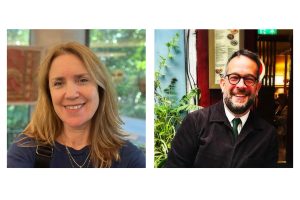
The Art Bulletin is pleased to announce its new co-editors, Maya Stanfield-Mazzi and Stephen Whiteman. CAA News is happy to introduce them here and has asked them a few questions to help members, readers, and future contributors get to know them a little better. Welcome Stephen and Maya!
Can you tell our members about your current academic posts and research interests?
Maya Stanfield-Mazzi: I am professor of art history at the University of Florida, where I have taught since 2008. I specialize in Latin American art, especially that of the Andean region during the autonomous and colonial eras. I have long been interested in textiles as expressions of Indigenous epistemologies, and the ways in which textile makers responded to outside influences from Europe and Asia. Departing from my past work on Catholic art patronage, my current book project considers secular visual culture in the mining city of Potosí, Bolivia, to chart early modernity within a colonial and multiethnic context. I am also interested in issues of cultural heritage and the ways in which art history as a discipline can be employed to preserve tangible resources and engage the broader public for current-day benefits.
Stephen Whiteman: I am professor in the art and architecture of China at the Courtauld Institute of Art, University of London, where I have taught since 2019. Prior to that, I taught at the University of Sydney for five years. I am also a Trustee of the Association for Art History, CAA’s peer organization in the United Kingdom. My research addresses questions of landscape, territory, and social and ethnic identity in China from roughly 1500 to the present. I am very engaged with digital methods in art history, as well as the potential for new approaches to the field afforded by digital alternatives to long-form writing. I am also interested in connected histories of art and architecture in China and Asia and the prospects of art history outside the construct of modern nation-states.
What is your vision for The Art Bulletin during your term as editors-in-chief?
We are excited and honored for the opportunity to steward one of the leading journals in our field during a challenging period. We are deeply invested in The Art Bulletin’s tradition of publishing art historical scholarship of the highest quality and maintaining the journal’s investment in the highest standards for editing and production. We look forward to building upon the work of previous editors in broadening the journal’s reach, demystifying its editorial processes, and working toward greater inclusivity in both authorship and readership. As scholars with expertise in two very distinct non-European fields, we are also interested in the opportunity to further extend The Art Bulletin’s voice and reach beyond its traditional ground and in ways that reflect the growth and evolution of the field over recent decades.
At the same time, we are acutely aware of the pressures that surround research, academia, and cultural institutions today. We want The Art Bulletin not just to be a journal of record, but also one that engages in ongoing conversations, within and beyond the discipline. What does art history have to contribute to the debates of today? How can art historians contribute to critical conversations or offer new perspectives on pressing issues? While we are not aiming to politicize The Art Bulletin, we hope that each issue will be one that readers want to read now, as well as in the future.
What motivated you to become E-I-Cs of The Art Bulletin? Why together? How does your research and public scholarship dovetail with your vision for the journal?
We are excited for the bird’s-eye view of the discipline that the co-editorship will offer. We both understand editorship of The Art Bulletin as an opportunity for service to the discipline. Likewise, we see editing as a form of mentorship. As such, we were each motivated by an interest in helping to shape the field through expanding opportunity, supporting research and professional development, and standing up for principles we share: academic freedom, the importance of research and the search for knowledge, and the essential role of art history and the humanities today. We were both excited about the possibilities of co-editorship. The collaborative arrangement has obvious practical advantages, but more importantly, we valued the broader perspective that two people working in different areas of the field necessarily brings to the role.
And finally, what are each of you reading/viewing these days? What is inspiring you—within and outside of the field?
SW: Within the field, I am finding a lot of inspiration in work that I feel stretches the boundaries of Chinese art and of the discipline more generally. This ranges from research on art and architecture beyond the major cultural centers of China, such as Xinjiang, Guangzhou, and Shandong, to work engaging new archives, non-Chinese languages, transcultural histories, and objects and spaces that lie outside the received canon. Away from work, I have been reading a great deal of fiction, including by authors whose narratives explore issues of identity, displacement, and relocation, such as Yvonne Owuor, Gerald Murnane, and Elif Shafak. As a migrant myself, albeit one who has moved by choice and from a privileged global position, I find much to think about in these books as I grapple with my own sense of place and seek to understand the larger experience of contemporary global migration of which I am a tiny part.
M S-M: In my research area I am struck by the current dialectic between mobility and groundedness. Scholars are showing the vast expanses across which images have traveled and their great potential for resignification, while others (often by looking closely at the archaeological record) are able to identify local narratives that arise from commitments to shared, and often very deep, pasts. Recently I have been inspired by the Beninese students featured in the 2024 film Dahomey, who passionately articulate the importance of historical artifacts for their own shared identities. With students increasingly using AI tools to express themselves, I am committed to fostering individual expression and, for art history, deepening our understanding of the nature of original research and thinking.
Apply Now for Fall 2025 Publication Grants + Grantees Announced!
posted by CAA — July 24, 2025
CAA is now accepting applications for the Millard Meiss Publication Fund and the Wyeth Foundation for American Art Publication Grant. These grants support book-length scholarly manuscripts in the history of art, visual studies, and related subjects that have been accepted by a publisher on their merits but cannot be published in the most desirable form without a subsidy.
The Millard Meiss Publication Fund supports the publication of books on any period or area of art history and visual studies.
The Wyeth Foundation for American Art Publication Grant supports the publication of books on the art of the United States, Canada, and Mexico.
Application instructions and criteria can be found here.
Deadline: September 15
Millard Meiss Publication Fund Spring 2025 Grantees
Ravinder Binning, The Medieval Art of Fear, The University of Chicago Press
Rebecca M. Brown, Modernism in Relation: KCS Paniker’s Written Pictures, J. Paul Getty Trust
Sylvia Cockburn, Unsettling Museums: Pacific Artists, Anthropology, and Collaborative Practice, University of Hawaiʻi Press
Danya Epstein, Hopi Futurist: The Art and Architecture of Dennis Numkena, University of Oklahoma Press
Sonal Khullar, The Art of Dislocation: Conflict and Collaboration in Contemporary Art from South Asia, University of California Press
Michele Lamprakos, Memento Mauri: The Afterlife of the Great Mosque of Cordoba, The University of Texas Press
Christopher J. Nygren, Sedimentary Aesthetics: Painting on Stone and the Ecology of Early Modern Art, Yale University Press
Florencia San Martin, Alfredo Jaar: Decolonial Time and the Aesthetics of the Unfinished, Duke University Press
Allison Young, Freedom as Form: Gavin Jantjes, Anti-Apartheid, and the Postwar Avant-Garde, Duke University Press
Wyeth Foundation for American Art 2024 Grantees
Annik Bilodeau, Pasting Up Protest: The Art of Memorializing Violence in Mexican Printmaking, McGill-Queen’s University Press
Alice Butler, Close Writing: Kathy Acker, Cookie Mueller, and Love-in-pieces, Duke University Press
Yve Chavez, Indigenizing California Mission Art and Architecture, University of Washington Press
Carolin Görgen, The California Camera Club: Collective Visions in the Making of the American West, University of Oklahoma Press
Harmony Hammond and Tirza True Latimer, Still Dangerous: The Harmony Hammond Reader, Duke University Press
Robb Hernández, Transplanetary: Speculative Arts of the Americas, Duke University Press
Joseph Harold Larnerd, Undercut: Cut Glass in Working-Class Life during the Long Gilded Age, University of Delaware Press
Michael Hartman and Jami Powell, eds., Reenvisioning Histories of American Art: Transforming Museum Practice, University of Washington Press
Jessica Lopez Lyman, Hard Land, U.S.A.: Latina/x Art, Performance, and Organizing in the Twin Cities, University of Minnesota Press
Maureen Meister, Arts and Crafts Architecture Across America, Yale University Press
John Ott, Mixed Media: The Visual Cultures of Racial Integration, 1931–1954, University of California Press
Louis Shadwick, Edward Hopper: Into the Light, Yale University Press
Jacob Stewart-Halevy, The Casual: Downplaying Art since California Conceptualism, University of Chicago Press
Nick Yablon, “From the Skyscraper to the Wildflowers”: Charles Gilbert Hine’s Photographic Survey of Broadway, University of Iowa Press
Congratulations to our grantees!
Apply for CAA Committee Service!
posted by CAA — May 15, 2025
Join one of CAA’s twelve Professional Committees, the Publications Committee, the Annual Conference Committee, or the Council of Readers as an at-large member! Each committee works from a charge established by the Board of Directors. For many CAA members, committee service fosters professional relationships, community, and facilitates impactful contributions to pressing issues in the visual arts and higher education.
Important Committee Service Information:
- Committee members serve a three-year term. Service for this cycle begins in February 2026 at the CAA 114th Annual Conference and concludes in February 2029 at the 117th Annual Conference.
- All applications are reviewed by current committee members as well as CAA leadership.
- Appointments will be announced by November 1, 2025. New members will be introduced to their committees during their respective business meetings at the CAA 114th Annual Conference in Chicago (February 18–21, 2026).
- If appointed, applicants are expected to attend committee meetings, participate actively in the work of the committee, and contribute expertise to defining the current and future work of the committee.
- Appointees must be current CAA members before the start of their service but do not need to be CAA members to apply.
- All committee members volunteer their service without compensation.
Use the links below to review the mission of each committee as well as the current roster of committee leadership and members:
CAA ANNUAL CONFERENCE COMMITTEE + COUNCIL OF READERS
The Annual Conference Committee and the Council of Readers play different but equally important roles in shaping the Annual Conference each year, ensuring the program reflects CAA’s goals: To make the conference an effective place for intellectual, aesthetic, and professional learning and exchange, to reflect the diverse interests of the membership, and to provide opportunities for participation that are fair, equal, and balanced.
Please Note: Unlike many committee service roles, the Council of Readers does not convene monthly; the bulk of their review work takes place each May/June. This is the perfect role for those who want to serve a three-year term but do not have the capacity to take on work year-round.
CAA PROFESSIONAL COMMITTEES
CAA’s twelve Professional Committees represent the constituent interests of the organization by addressing standards, practices, and guidelines in the professions of our individual and institutional members.
- Committee on Design
- Committee on Diversity Practices
- Committee on Intellectual Property
- Committee on Research and Scholarship
- Committee on Women in the Arts
- Education Committee
- International Committee
- Museum Committee
- Professional Practices Committee
- Services to Artists Committee
- Services to Historians of Visual Arts Committee
- Student and Emerging Professionals Committee
CAA PUBLICATIONS COMMITTEE
The Publications Committee oversees CAA’s publishing activities and supervises the Editorial Boards of The Art Bulletin, Art Journal/Art Journal Open, and caa.reviews
Please Note: At-large members of the Publications Committee represent the voice of our membership, and perform the role of committee secretary, taking minutes at three Publications Committee meetings per year in February, spring (April or May), and fall (September or October).
If you are interested in serving on a CAA committee, please click the APPLY TO SERVE button below to fill out the application form and upload your CV as well as a brief personal statement describing your interest and experience (250 words maximum). If you are applying to more than one committee, please submit a separate personal statement tailored to each of the committees to which you are applying, noting why you’d like to serve on that specific committee.
Contact Maeghan Donohue, CAA Chief of Staff and Director of Strategic Planning, Diversity & Governance with any questions.
Deadline: July 25, 2025
Join the CAA Board of Directors!
posted by CAA — May 13, 2025
Now accepting Board of Directors nominations for the 2026–30 term (2026–28 for Emerging Professional Directors)! CAA seeks individuals passionate about shaping the future of the organization and the field. The Board is responsible for financial and policy matters related to CAA in collaboration with the Executive Director & CEO, as well as promoting excellence in scholarship, curation, design, and art practice. CAA’s Board is also charged with representing CAA and advocating for the membership regarding current issues affecting the visual arts and humanities.
Nominations and self-nominations must include the following:
- Nominee name, affiliation, and email address
- Nominator name, affiliation, and email address (if different from nominee)
- Nominee résumé/CV
- Nominee statement of interest (250 words maximum)
Please send nominations and questions via email to Maeghan Donohue, CAA Chief of Staff & Director of Strategic Planning, Diversity, and Governance, with the subject line: Board of Directors Nomination.
Deadline: July 11, 2025
CAA Signs on to ACLS + Council of Graduate Schools + The Phi Beta Kappa Society Joint Statement on Cuts to the NEH
posted by CAA — April 04, 2025
CAA has signed on to the American Council of Learned Societies (ACLS), Council of Graduate Schools (CGS), and The Phi Beta Kappa Society joint statement on cuts to the National Endowment for the Humanities (NEH). In conjunction with these societies, we encourage the current administration to reconsider dramatic reduction of staff and ask Congress to protect the NEH.
“Critical thought, cultural memory, and wisdom fostered by the humanities remain crucial to a vibrant democracy. The NEH has upheld these values since its founding. For less than the cost of a postage stamp to every American, the NEH’s thoughtful grantmaking helps community and scholarly life thrive.”
Read the full statement here.
OTHER LEARNED SOCIETIES AND INSTITUTIONS WHO HAVE SIGNED ON TO THE JOINT STATEMENT
American Academy of Religion
American Association for Italian Studies
American Folklore Society
American Historical Association
American Musicological Society
American Philosophical Association
American Political Science Association
American Society for Theatre Research
American Society of Overseas Research
American Sociological Association
American Studies Association
Association for Asian Studies
Association for Slavic, East European, and Eurasian Studies
Association for the Study of African American Life and History
Association of Research Libraries
Association of University Presses
Linguistic Society of America
North American Conference on British Studies
Oral History Association
Organization of American Historians
Renaissance Society of America
Society of Biblical Literature
CAA Publications Need You—Apply to Serve on a Journal!
posted by CAA — April 03, 2025
Be a part of the beating heart of CAA! Three of CAA’s field-leading publications are seeking candidates to fill several Board seats and editorial positions!
- Art Journal Open is seeking an Editor-in-Chief to serve a three-year term
- Art Journal is seeking a Reviews Editor to serve a three-year term
- caa.reviews is seeking an Editor-in-Chief to serve a three-year term and a Field Editor in the area of theory and historiography to serve a three-year term.
Descriptions of the roles, expectations, and detailed application instructions are provided in the links above.
Deadline: May 16
CAA Signs on to National Humanities Alliance Statement on Threats to the NEH
posted by CAA — April 03, 2025
CAA has signed on to the National Humanities Alliance (NHA) statement on threats to the National Endowment for the Humanities (NEH), released in response to the Department of Government Efficiency (DOGE) targeting the NEH. DOGE aims to reduce staff, cut grant programs, and rescind grants that have already been awarded. CAA stands with NHA in supporting the NEH mission and appealing to members of Congress to intervene and ensure the NEH fulfills its Congressional mandate. Along with NHA and several other societies, CAA fervently believes the NEH “…has a positive impact on every congressional district,” and “…cutting NEH funding directly harms communities in every state and contributes to the destruction of our shared cultural heritage.”
Read the full statement here. We strongly urge the CAA community to act by contacting Congress in support of the NEH. You can do so in a matter of moments via this easy form!
OTHER LEARNED SOCIETIES AND INSTITUTIONS WHO HAVE SIGNED ON TO THE NHA STATEMENT
American Academy of Religion
American Antiquarian Society
American Association for Italian Studies
American Association for State and Local History
American Historical Association
American Musicological Society (AMS)
American Oriental Society
American Philosophical Association
American Society for Eighteenth-Century Studies
American Sociological Association
Association for Asian Studies
Association of Research Libraries
Association for Slavic, East European, and Eurasian Studies
Association of University Presses
Coalition of State Museum Associations (COSMA)
German Studies Association
Linguistic Society of America
Modern Language Association
National Council on Public History
National Council of Teachers of English (NCTE)
North American Conference on British Studies
Organization of American Historians
The Phi Beta Kappa Society
Renaissance Society of America
Society of American Archivists
Society of Biblical Literature
University of Connecticut Humanities Institute (UCHI)
CAA Signs on to the American Historical Association Statement Defending the Smithsonian
posted by CAA — April 03, 2025
CAA has signed on to the American Historical Association (AHA) statement defending the Smithsonian Institution after the release of a recent executive order and accompanying fact sheet claiming Smithsonian museums are displaying “…improper, divisive, or anti-American ideology.” This is a gross mischaracterization of the role and impact of the Smithsonian.
“Patriotic history celebrates our nation’s many great achievements. It also helps us grapple with the less grand and more painful parts of our history. Both are part of a shared past that is fundamentally American. We learn from the past to inform how we can best shape our future. By providing a history with the integrity necessary to enable all Americans to be all they can possibly be, the Smithsonian is fulfilling its duty to all of us.”
Read the full statement in defense of the institution here.
OTHER LEARNED SOCIETIES AND INSTITUTIONS WHO HAVE SIGNED ON TO THE AHA STATEMENT
American Association for Colleges of Teacher Education
American Association of Geographers
American Society for Environmental History
Association for Slavic, East European, and Eurasian Studies
Association for the Study of African American Life and History
Association of Research Libraries
Civil Rights Movement Archive
Conference on Asian History
Education4All
Kurt Vonnegut Museum and Library
Labor and Working Class History Association
LGBTQ+ History Association
Midwestern History Association
National Association of Diversity Officers in Higher Education
National Council on Public History
Network of Concerned Historians
North American Victorian Studies Association
Oral History Association
PEN America
Society for Historians of the Gilded Age and Progressive Era
Society for the History of Children and Youth
Society for US Intellectual History
Southern Association for Women Historians
Woodhull Freedom Foundation
CAA Signs on to The Phi Beta Kappa Society + ACLS Joint Statement on Executive Order to Dismantle Department of Education
posted by CAA — March 24, 2025
CAA has signed on to the Phi Beta Kappa Society and The American Council of Learned Societies (ACLS) joint statement addressing the Executive Order to close the US Department of Education. We join these societies in urging the administration to rescind this order, given the “…catastrophic implications for students, faculty, communities, and the nation.”
Read the full statement here. We strongly urge those in the CAA community to also make use of The Phi Beta Kappa Society toolkit, which contains resources to guide how members can take action.
OTHER LEARNED SOCIETIES WHO HAVE SIGNED ON TO THE PHI BETA KAPPA SOCIETY + ACLS JOINT STATEMENT
American Association for Italian Studies
American Association of Geographers
American Folklore Society
American Historical Association
American Philosophical Association
American Political Science Association
American Society for Environmental History
American Society for Theatre Research
American Society of Overseas Research
American Sociological Association
Association for Asian Studies
Association for Slavic, East European, and Eurasian Studies
Association for the Study of African American Life and History
German Studies Association
Linguistic Society of America
Modern Language Association
National Council on Public History
North American Conference on British Studies
North American Victorian Studies Association
Organization of American Historians
Renaissance Society of America
Rhetoric Society of America
Society for Cinema and Media Studies
Society of Biblical Literature
CAA Signs on to AHA–OAH Joint Statement on Federal Censorship of American History
posted by CAA — March 17, 2025
CAA has signed on to the American Historical Association (AHA) and the Organization of American Historians (OAH) joint statement on Federal Censorship of American History.
We stand with AHA and OAH in recognizing the historical dangers of censorship and in condemning “…recent efforts to censor historical content on federal government websites, at many public museums, and across a wide swath of government resources that include essential data. New policies that purge words, phrases, and content that some officials deem suspect on ideological grounds constitute a systemic campaign to distort, manipulate, and erase significant parts of the historical record. Recent directives insidiously prioritize narrow ideology over historical research, historical accuracy, and the actual experiences of Americans.”
OTHER LEARNED SOCIETIES AND INSTITUTIONS WHO HAVE SIGNED THE AHA-OAH JOINT STATEMENT
American Academy of Religion
American Studies Association
Association of University Presses
Conference on Asian History
Education for All
French Colonial Historical Society
Historians for Peace and Democracy
Labor and Working-Class History Association
National Council for the Social Studies
National Council on Public History
Network of Concerned Historians
North American Conference on British Studies
PEN America
Society for US Intellectual History
Society of Architectural Historians
Western History Association
World History Association